Service Pathways
Child Criminal Exploitation (CCE), requires a coordinated, preventative, and trauma-informed response. A Public Health Approach provides a strategic framework that addresses exploitation at multiple levels, and offers a practical and effective way to organise services and the pathway through them.
Using a Public Health Approach to Address Child Criminal Exploitation (CCE)
A Public Health Approach provides a strategic framework that addresses exploitation at multiple levels, and offers a practical and effective way to organise services and the pathway through them. It focuses on preventing exploitation before it happens, mitigating its impact at population level, identifying risks early, and supporting children and young people who have already been harmed.
This approach recognises CCE as a complex issue influenced by multiple factors across different levels of society. It shifts the focus from crisis response to prevention, early intervention, and recovery, ensuring children and young people are safeguarded, supported, and given the opportunity to thrive. It emphasises evidence-based interventions, data driven decision making, and a focus on population-level outcomes.
A public health approach consists of four key steps:
- Define and monitor the problem by gathering data on the nature, scope, and patterns of occurrence
- Identify risk and protective factors by understanding the social, environmental, and individual factors that increase or reduce vulnerability
- Develop and test prevention strategies by designing evidence-informed interventions that address root causes and build resilience
- Ensure widespread adoption of effective strategies by scaling up effective strategies through policy, practice, and community engagement.
- In relation to addressing CCE the operationalisation of the public health approach is demonstrated through the 4 levels, known as Hardiker levels, of the child safeguarding system in Northern Ireland, namely
Level 1 – Universal Prevention and social development services
Level 2 – Support and therapeutic intervention for children and families in need
Level 3 – Therapeutic and support services for children and families with severe difficulties
Level 4 – Intensive and long- term support and protection for children and families
For practitioners who work in the child safeguarding system, the Hardiker levels will be familiar and will frame their work, in partnership with others, associated with assessment of need undertaken through the Understanding the Needs of Children in Northern Ireland (UNOCINI) process.
However, to simplify the service pathways workflow that practitioners will navigate in order to engage with the appropriate service pathways, it has been divided into 3 stages;
Primary Prevention
Provision of universal services with the aim of preventing CCE occurring
Secondary Prevention
Provision of early intervention to support children and young people at risk of CCE and to prevent escalation
Tertiary Prevention
Activity to ensure the safety, support recovery, and provide long-term, holistic care of children and young people who have or are experiencing criminal exploitation.
Diagram 1 below depicts the service pathways that will be followed by practitioners based on assessed risk and need, to either prevent or support children and young people at risk of or experiencing CCE.
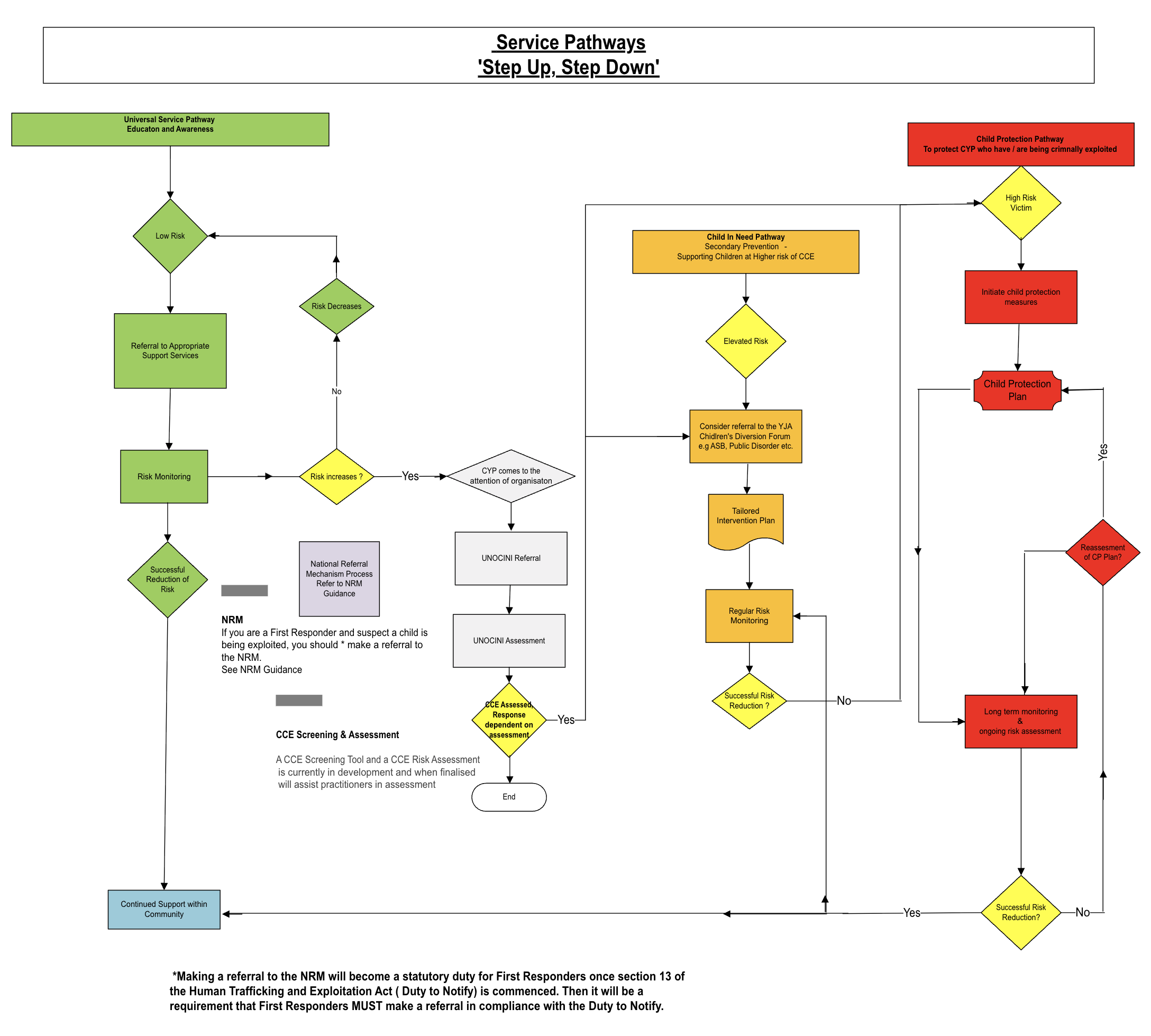
Practitioners may access the service pathway at different stages, recognising that children and young people affected by criminal exploitation may move between levels of support – ‘stepping up’ and ‘stepping down’ based on their changing risk and need.
Based on a sequential flow the following narrative describes how the service pathway is accessed and details examples of strategies that are relevant to each stage.
By capturing information across key domains, developmental needs, parenting capacity, and family/environmental factors UNOCINI enables practitioners to:
- Identify early signs of vulnerability.
- Understand the contextual factors influencing risk and resilience.
- Inform appropriate pathways, whether through Family Support, Child Protection, Looked After Child, or Leaving Care services.
Stage 1 - Primary Prevention
Universal Service Pathway – education and prevention
Primary prevention aims to stop CCE before it starts by addressing the root causes of vulnerability and promoting protective environments. All children and young people benefit from universal services such as education, healthcare, and youth support, which play a foundational role in safeguarding. While a preliminary UNOCINI assessment could be completed by a health practitioner and it does not meet the threshold for referral to formal UNOCINI assessment by a Social Worker, it may result in other referrals and actions such as referral to community and voluntary sector support services.
Children and young people may become more susceptible to CCE when they have large amounts of unsupervised time and increased presence on online spaces, or other vulnerabilities that heighten their susceptibility to CCE. These can be understood as indicators that the child may fall within the definition of a Child in Need under Article 17 of the Children (Northern Ireland) Order 1995, which is used in practice to determine safeguarding thresholds.
Early identification of these vulnerabilities is critical to safeguarding children and young people, through a coordinated, multi-agency approach. Parents, carers, and practitioners working in education or universal services often have the closest day-to-day contact with children and young people and may be the first to notice signs of concern. However, it is essential that all services remain alert to early indicators of vulnerability or CCE, and respond with care, curiosity, and coordination.
Examples of primary prevention strategies: Universal approaches that aim to reduce risk and build protective environments before harm occurs:
- School-based education programmes on healthy relationships, consent, recognising manipulation, and online safety delivered in age-appropriate, inclusive ways.
- Inclusive school environments – whole-school approaches that promote
belonging, reduce exclusion, and support engagement for all learners. - Community awareness campaigns. Public education initiatives to raise awareness of CCE and challenge stigma and myths.
- Policy and structural initiatives aimed at reducing poverty, improving access to education, and addressing systemic inequalities and deprivation that increase vulnerability.
- Parenting and family support programmes delivered through Family Support Hubs to strengthen family relationships, build resilience, and support early help.
- Youth development programmes and activities that foster confidence, leadership, and life skills, helping young people build positive identities and aspirations.
- Safe community spaces through urban planning and community development that prioritise safe, inclusive environments for children and young people.
- Media and digital literacy awareness raising that empowers children and young people to critically assess online content, resist harmful influences, and stay safe online.
- Measuring impact - While baseline data on CCE in Northern Ireland is limited, progress can be tracked through indicators such as increased awareness and understanding of CCE, improved practitioner confidence and training, stronger multi-agency collaboration, and positive shifts in community and public attitudes toward exploitation and safeguarding.
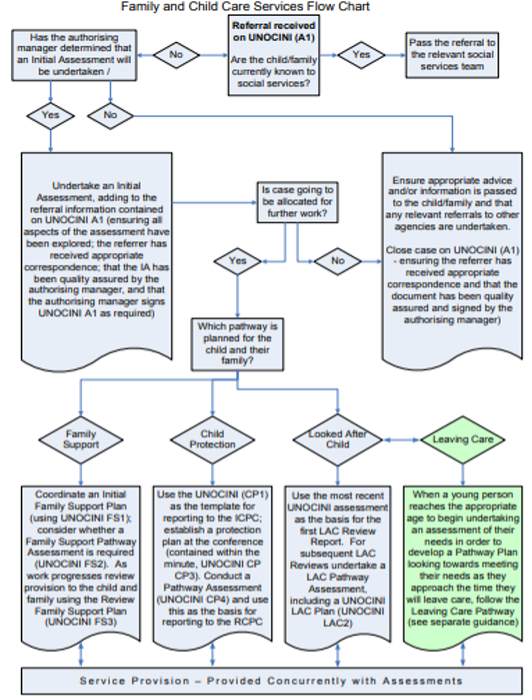
Diagram 2 above provides a structured overview of the multi-agency service provision for responding to CCE in Northern Ireland. It integrates both Child Safeguarding and Child Protection systems, recognising that children and young people affected by exploitation may move between different levels of support depending on their changing levels of risk and need. The submission of a UNOCINI assessment is intended to address the presenting issues of a “Child in Need.” This ensures that concerns related to vulnerability, risk of exploitation, or early indicators of harm are responded to within the statutory framework and that appropriate multi‑agency support is coordinated effectively.
Stage 2 - Secondary Prevention – Supporting Children at Higher Risk of CCE
Family Support Pathway – early help for emerging concerns
Secondary prevention focuses on children and young people who are at increased risk of CCE due to contextual, familial, peer, or individual factors. These factors may include paramilitary influence, community violence, family breakdown, school exclusion, or housing instability. Children and young people may not recognise they are being targeted, especially when coercion is subtle and embedded in relationships.
The Family Support Pathway can be initiated when early signs of harm emerge. Practitioners play a key role in identifying concerns, applying professional judgement, and completing a UNOCINI assessment to inform appropriate support.
Warning signs can include disengagement from education, unexplained possessions, frequent absences, or contact with the justice system, which may reflect underlying exploitation. Practitioners are encouraged to look beyond presenting behaviours and ask what has happened to this child.
In the context of CCE, secondary prevention involves practitioners:
- Using UNOCINI assessments to understand the full context of the child or young person’s circumstances and needs and to inform support plans.
- Assessing vulnerabilities through practitioner-led discovery of CCE, using professional curiosity, careful observation, and the development of trusted relationships.
- Listening to the voices of children, young people, and families to co-create meaningful, practical solutions
- Initiating Inter-agency Referral Discussions (IRD) when concerns escalate.
- Empowering families through collaborative planning and voluntary engagement.
- Co-ordinating support through the Family Support Pathway and developing Family Support Plans with multi-agency input.
- Provide trauma-informed, non-stigmatising support.
- Liaising with youth services, schools, families, and community organisations to share concerns and coordinate support.
- Providing timely, proportionate interventions that address emerging risks.
- Aiming to prevent escalation to statutory intervention through multi-agency collaboration and empowerment of families.
Examples of secondary prevention interventions to support children and young people at higher risk of CCE:
- Targeted mentoring programmes and peer support groups to respond to contextual risks in high-crime or high-risk areas with a focus on safeguarding, developing safety and contingency planning and building trust.
- Family Support Hubs offering practical help, parenting support, and signposting to community resources. Tailored support for families experiencing known risk factors such as parental mental health challenges, or housing instability, to strengthen protective factors and reduce vulnerability.
- Provision of universal services - midwives, public health nurses, delivering targeted interventions to children, young people, families and communities.
- Specialist education support and programmes for children and young people excluded from mainstream education, offering inclusive, trauma-informed learning environments and pathways to re-engagement.
- Proactive outreach and engagement services to children who are homeless, missing from care, or disengaged from services, ensuring they are supported in safe, non-judgemental ways.
- Support for young people in conflict with the law. Interventions through Youth Justice Agency (e.g. Children’s Diversion Forums) or youth services that recognise the role of exploitation and trauma in lower-level offending, focusing on personal growth and development to desist from further offending, and resilience-building.
- National Referral Mechanism (NRM) referrals should be completed for all suspected child victims of exploitation. Relevant criteria are outlined in section 2 of the NRM Guidance.
- Skills and empowerment interventions including strengths-based programmes for children and young people with learning difficulties or behavioural needs, promoting self-efficacy, emotional regulation, and positive identity development.
- Health Services addressing physical and emotional wellbeing, including access to CAMHS, if needed.
- Community and Voluntary Sector organisations offering tailored support such as counselling, advocacy, and peer support.
Stage 3 - Tertiary Prevention – Protecting and Minimising Impact of Children and Young People Who Have Been Exploited
Child Protection Pathway
Tertiary prevention focuses on children and young people at immediate risk or already experiencing significant harm due to CCE. At this stage the Child Protection Pathway is activated. Children and young people often face complex trauma and remain at risk of continued or repeat harm. This level of intervention involves intensive, statutory safeguarding and long-term support to ensure safety, disrupt perpetrators of CCE, and promote recovery.
In the context of CCE, tertiary prevention priorities include:
- An allocated Social Worker who takes responsibility for activating the Child Protection Pathway to remove the child from danger following an Inter-agency Referral Discussion (IRD) and Child Protection Case Conference.
- Development of a Child Protection Plan or A Looked After Care Plan where the child or young person is in the care of a HSCT either through voluntary accommodation or legal orders, should be undertaken in line with the Protecting Looked After Children (PLAC) guidance, with urgent safeguarding actions clearly outlined.
- Multi-agency response (PSNI, HSCT, Education Services, Youth Justice, CVS) to disrupt perpetrators and exploitation networks through multi-agency safeguarding and enforcement.
- NRM referrals should be completed for all suspected child victims of exploitation. Relevant criteria are outlined in section 2 of the NRM Guidance.
- Across Northern Ireland, the Independent Guardian Service offers support and guidance to children and young people who have been, or are suspected to have been, trafficked. The role of an Independent Guardian is outlined in the Human Trafficking and Exploitation (Criminal Justice and Support for Victims) Act (Northern Ireland) 2015. The purpose of the role is to strengthen the protections available to children and young people who have been, or may have been, victims of human trafficking and/or who are separated from their primary caregivers. Further information can be accessed in the IGS Guidance. Where a child is not Looked After but requires safeguarding support, practitioners should consider the Child in Need Plan/Pathway.Emphasis is on contextual safeguarding and a flexible, responsive approach to changing levels of risk.
- Intensive case management and wraparound services tailored to individual needs.
- Review and Monitoring timelines - regular Core Group meetings should be held to review the plan, with adjustments made in response to the child or young person’s changing needs and circumstances. Where the child or young person is Looked After, reviews must be carried out in compliance with the Protecting Looked After Children (PLAC) Guidance and its associated requirements.
Examples of tertiary prevention strategies:
- Trauma-informed therapeutic support - Access to specialised counselling and mental health services such as CAMHS or support for substance misuse.
- Safe and supportive accommodation to remove the child or young person from exploitative environments (e.g., foster care, residential care). Safety planning may include additional risk assessments (e.g., Threat to Life) and supervision strategies.
- Education and employment pathways – programmes that support re-engagement with education, training, and employment, helping young people rebuild confidence, skills, and future aspirations.
- Intensive case management which requires coordinated, multi-agency support through dedicated practitioners, ensuring continuity of care and responsiveness to complex needs.
- Peer support and mentoring providing opportunities for children and young people to connect with trained mentors or peers with lived experience, fostering trust, belonging, and hope.
- Family and Community Support to help reduce risk factors (e.g., housing, financial support, parenting help, creating safe spaces).
- Transition planning for older young people preparing to leave care to empower them to plan for their future as this is recognised as a period of risk.
- Restorative justice approaches that recognise the role of coercion and trauma in offending behaviours, promoting safety and desistance.
- Disruption and protection measures – targeted actions to disrupt exploiters and safeguarding children and young people, including intelligence-led policing, community safety initiatives, and contextual safeguarding strategies.
Transitional Safeguarding
It is essential to emphasise the importance of safeguarding continuity as young people move from children’s services into adult services. A joined-up approach that integrates adult safeguarding procedures with children’s safeguarding will help maintain consistency in risk management, safety planning, and prevention.
Collaborative working between both service areas is critical to avoid gaps in support that perpetrators could exploit when statutory children’s services end and adult services have not yet begun. Early identification of risk and joint planning will enable holistic, long-term support that addresses ongoing vulnerabilities and recognises that harm can continue beyond the age of 18.
This approach ensures safeguarding does not stop at the point of transition but flows seamlessly, promoting resilience and sustained protection. Developing shared information-sharing tools beyond existing processes (such as Looked After Children, Child Protection, UNOCINI, and NRM) will further support frontline practitioners and enable effective day-to-day collaboration.
Key Takeaways for Practitioners supporting children and young people at risk of or experiencing CCE.
- Understand your role within the system-wide pathway.
- Use the UNOCINI assessment to identify and document CCE concerns.
- Refer confidently using clear thresholds and triggers.
- Collaborate across agencies to ensure consistent and effective responses, including an NRM referral by a first responder.
- Apply the public health model to prevent, intervene, and support recovery
"Invest in building relationships of trust: Relationships of trust are fundamental to being able to identify young people's needs and vulnerabilities. This requires time (long term engagement/interventions), safe spaces and structured processes for young people to engage and develop the confidence to share their feelings and concerns or for these vulnerabilities to become visible to practitioners, enabling targeted support." Why Riot